From Food Security to Farmer Prosperity:
Why States Must Back Nuts & Dry Fruits Cash Crops
India has made strong gains in food availability. The next step is farmer prosperity. Nuts and dry fruits can raise incomes, build rural jobs, and open export doors. States must lead on groundwork, supported by national schemes and an industry coordination body, such as the Nuts & Dry Fruits Council (India).
NDFC(I) represents the industry across India, with a wide product portfolio and membership strength.
Why promote domestic nuts & dry fruits growing?
- Save foreign exchange: Grow more high-value crops domestically, import less.
- Income security: Staples ensure food on the table; cash crops like walnuts, almonds, cashews, raisins and makhana help families move ahead.
- Higher returns per acre: Diversification into tree nuts and makhana can lift farm earnings.
- Jobs & MSMEs: Processing, packaging and logistics create local employment – often with strong participation by women.
- Ecosystem growth: Nurseries, training, testing labs, cold chains and branding strengthen the whole value chain.
Central government has already set the wheels in motion
- MIDH – Mission for Integrated Development of Horticulture
MIDH supports end-to-end horticulture: plantation, orchard development, post-harvest, cold chain, marketing and training. It also drives cluster development and the Clean Plant/ quality planting material push – vital for nuts and fruit crops. States can plan clusters and access funds under this mission. - eNAM – electronic National Agriculture Market
A pan-India online mandi network that improves price discovery, market access and quick digital payments for farmers and FPOs. - PMFBY – Pradhan Mantri Fasal Bima Yojana
Insurance support for crop loss due to weather, pests or disease. Including nuts and dry fruits under PMFBY reduces risk and stabilizes income. - Established Cashew institutions that help farmers
Directorate of Cashewnut & Cocoa Development (DCCD), set up by the Government of India, works to increase production and productivity, accredit nurseries and run farmer training – directly benefiting cashew growers.
Cashew Export Promotion Council of India (CEPCI) promotes exports, connects Indian processors with buyers and supports market development – creating steady demand for farmer produce. - RKVY – Rashtriya Krishi Vikas Yojana (National Agriculture Development Scheme)
This scheme funds state led, farmer oriented projects including pre and post harvest, value addition and marketing – giving states the flexibility to back nut and dry fruit clusters. (Press Information Bureau) - AIF – Agriculture Infrastructure Fund
Affordable finance for post-harvest infrastructure like cold storages, pack houses, assaying/ testing and logistics not just for crop cultivation. As of June 30th, 2025, over Rs 66,000 crore has been sanctioned for Rs 1.13 lakh projects, including 2,454 cold storages. - Prime Minister’s announcement of a Makhana Board (Budget 2025)
The Union Budget 2025 announced a Makhana Board in Bihar. Hon’ble Prime Minister Shri Narendra Modi mentioned that the board will help farmers across production, processing, value addition and marketing – positioning makhana for national and global markets.
States Must Lead: Action That Fits Farmers’ Needs
- Use central schemes efficiently: Combine MIDH for planting material and clusters, PMFBY for risk cover, eNAM for better prices, RKVY for flexible projects and AIF for cold chains and pack houses.
- Budget proactively: Allocate a fair share of central funds provided to the state to nuts and dry fruits cluster, not only staples to improve yield cost per acre.
- Match crops with terrain: Each state should assess which nuts and dry fruits grow best in its soil and climate. Support farmers to plant those crops so that yield per hectare and income per hectare increase sustainably.
- Sapling & nurseries: Establish accredited nurseries and ensure farmers get healthy saplings and effective planting material.
- Farmer training: Run practical training on orchard layout, drip irrigation, pruning, pest management, grading and packaging.
- Post-harvest facilities: Build village level pack houses, cold storage and labs using AIF/MIDH funds – so farmers reduce waste and get better prices for their yield.
- Export readiness: Link clusters with testing, certification and buyer networks to open global markets.
- Collaborate with national bodies like NDFC(I): National industry bodies such as the Nuts & Dry Fruits Council (India) can play a supportive role by uniting growers, processors, traders and exporters. Through platforms like MEWA India, policy dialogues and farmer focused workshops, such councils help ensure farmers gain both better market access and stronger policy backing.
NDFC(I): Ready to support farmers
- Workshops (with states): NDFC(I) in close coordination with agencies such as APEDA, FSSAI and NIN, can organise practical training on growing, harvesting, cleaning, grading (in conformity with global standards) and packing. Alongside these efforts, NDFC(I) can also help farmers and FPOs connect with potential exporters through buyer-seller meets and trade linkages.
- Quality & Safety Check Camps: Simple tips for farmers to identify good quality, avoid hygiene mistakes, follow easy food-safety rules and understand the process of getting FSSAI certification for their produce.
- Processing & Storage Demos: Practical demonstrations on machine vs sun drying, sorting, grading and modern storage options – so farmers and MSMEs can choose better methods and reduce losses.
- Export Guidance: Step-by-step help on paperwork, labelling and preparing samples, along with advice on branding to make Indian produce attractive to global buyers.
- Support for Infrastructure: Assistance to use schemes like AIF and MIDH to set up pack houses, grading lines, solar storage etc – cutting waste and raising returns.
- Market Access: Wider buyer linkages and global exposure through platforms like MEWA India and curated B2B meets.
- Policy & Value Chain Advisory: Incentives, nursery networks, cold chain maps – so every step adds value and income.
- Consumer Awareness Drives: City-based programs, recipe demos and “how to pick good quality’ stalls to boost demand for nuts and dry fruits.
A clear vision ahead
Think what suits the region or climate: walnuts in temperature belts (J&K, Himachal, Uttarakhand); almonds in suitable hills; makhana in Bihar’s ponds; cashew along suitable coastal and sub tropical zones. Each region grows what fits its land and water, diversifying income beyond staples. With modern pack houses and cold chains close to farms (AIF/MIDH) and market access (eNAM/exports), farmers become agri-entrepreneurs.
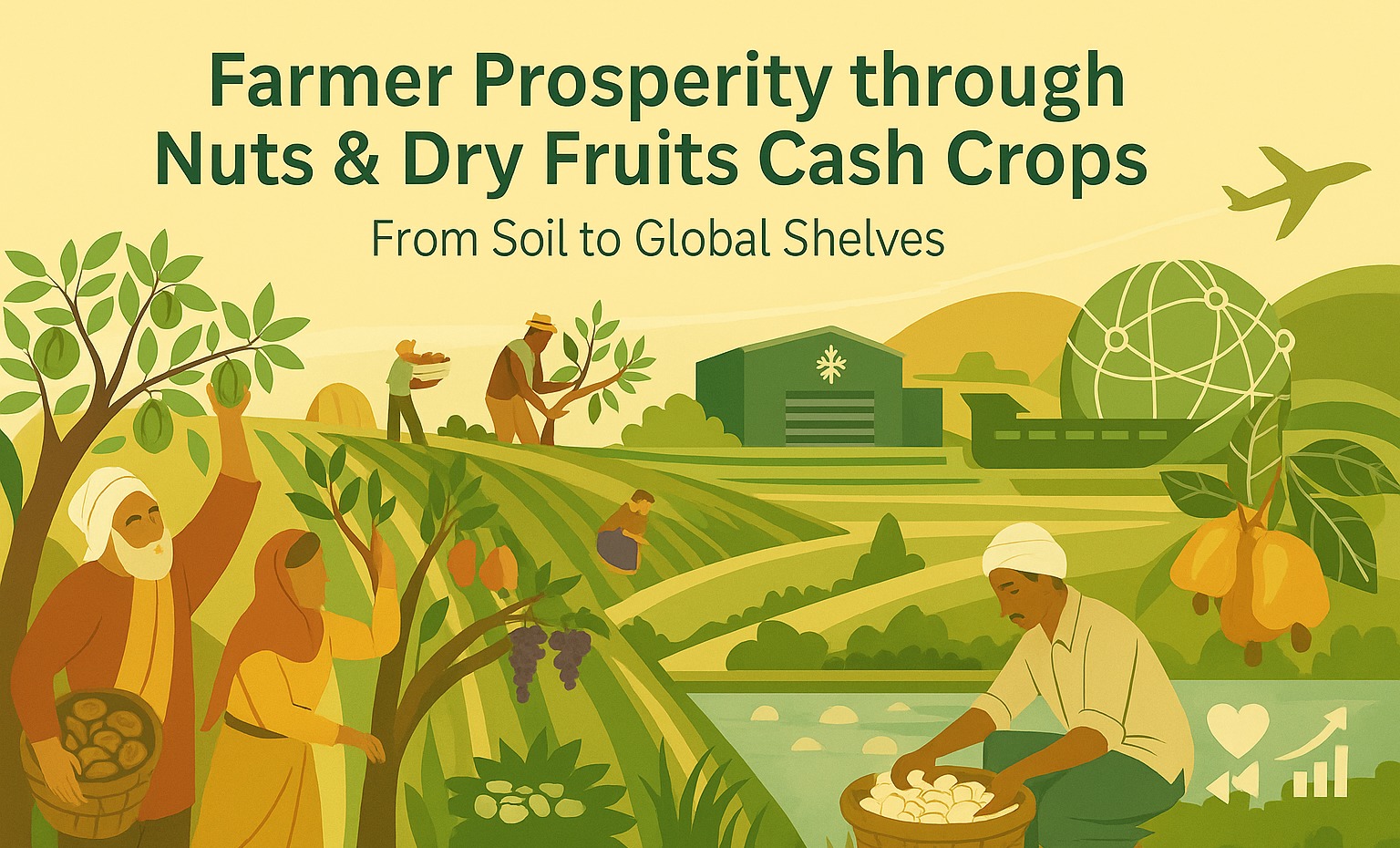
From soil to global shelves, nuts & dry fruits can be India’s next rural growth story – led by states, enabled by national schemes and supported by NDFC(I).
To know more about NDFC(I) or get associated with the Council, contact: 7042009241 | events@ndfci.org